
Beyond Compliance: Why Accurate Feeding, Counting, and Verification Matter in Pharmaceutical Packaging
In pharmaceutical manufacturing, quality is not measured only by the product inside the package—it is also measured by the integrity of every operation that takes place before the product reaches the patient. A single packaging error can result in production downtime, costly rework, product recalls, regulatory observations, or, even worse, risks to patient safety.
Many of these problems begin with seemingly simple processes: feeding, counting, identifying, and verifying flat materials such as cartons, pouches, labels, leaflets, instructions for use, and other packaging components.
Small Errors Can Have Big Consequences
A missing patient leaflet, an incorrect carton, an unreadable barcode, or a pouch sealed without its contents may seem like isolated incidents, but in a pharmaceutical environment they can quickly become major quality issues.
Similarly, manual counting or feeding of packaging materials can lead to shortages, overages, incorrect documentation, product mix-ups, and incomplete packages. Besides increasing labor costs and reducing productivity, these errors generate investigations, batch holds, customer complaints, and unnecessary waste.
Another common challenge involves pouches containing medical devices, swabs, gauze, or other healthcare products. If the product is missing, folded incorrectly, or trapped in the sealing area, the defective pouch may not be detected until it reaches the customer unless an effective inspection process is in place.
Traceability Is No Longer Optional
Regulations such as the Drug Supply Chain Security Act (DSCSA) have raised the standards for product identification and traceability throughout the pharmaceutical supply chain.
Manufacturers must ensure that packaging components are correctly identified, serialized, and verified before entering the next production stage. Every barcode, lot number, expiration date, serial number, and printed identifier must be accurate and readable.
Failure to verify this information can result in rejected batches, production delays, compliance issues, and significant financial losses.
Complete Verification Throughout the Packaging Process
Modern pharmaceutical production increasingly relies on automated verification systems capable of performing 100% inspection rather than relying on manual sampling.
These systems can:
- Verify barcodes, DataMatrix codes, and QR codes.
- Inspect human-readable information using OCR.
- Confirm lot numbers, expiration dates, and serial numbers.
- Verify that the correct carton, leaflet, label, or pouch is being used.
- Detect missing, duplicated, or incorrectly printed information.
- Generate electronic records that support batch documentation and traceability.
- Reject defective components before they enter downstream operations.
By identifying problems immediately, manufacturers reduce waste while improving quality assurance and regulatory compliance.
Solving Multiple Problems with One Automated Process
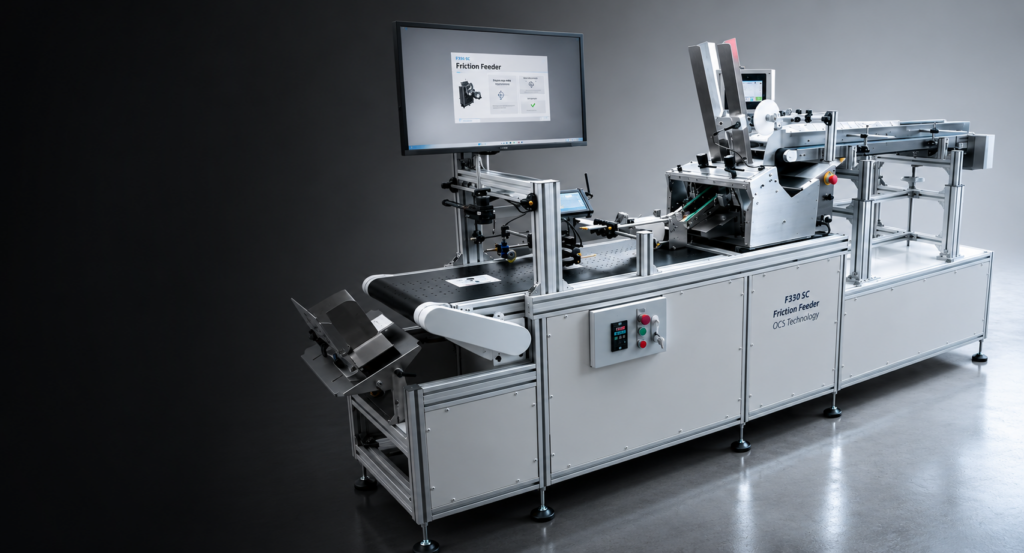
One technology can address several of these challenges simultaneously: a friction feeder integrated with printing, barcode reading, OCR verification, vision inspection, counting, and batching systems.
By presenting every component individually and consistently, the system enables high-speed inspection while simultaneously feeding, counting, printing variable information, and verifying every item before it enters the packaging process.
The same solution can:
- Detect pouches with missing or misplaced contents before shipment.
- Verify that every carton, leaflet, or label belongs to the correct product and batch.
- Print and immediately verify barcodes, QR codes, or human-readable information.
- Count and batch components accurately, eliminating manual counting errors.
- Support serialization and traceability initiatives required under DSCSA.
- Generate production data that improves quality control and process accountability.
A Smarter Approach to Pharmaceutical Packaging
Automation is no longer simply a way to increase production speed—it has become an essential tool for protecting product quality, maintaining regulatory compliance, and safeguarding patient safety.
When feeding, counting, printing, and verification are integrated into a single automated process, pharmaceutical manufacturers gain better traceability, fewer production errors, lower operating costs, and greater confidence that every package leaving the production line contains exactly what it should.
In an industry where there is virtually no tolerance for mistakes, investing in technologies that improve process reliability is not only a sound operational decision—it is an investment in quality, compliance, and customer trust.